Supporting Children Through Self-Control in Early Childhood
It’s 4:45 p.m. You’re chopping vegetables, your phone is buzzing, and your four-year-old is on the floor because the blue cup is in the dishwasher. Not broken. Not missing. Just unavailable. The crying feels outsized. The refusal to move feels stubborn. You might hear yourself thinking, “We’ve talked about this. You know better.”
But in early childhood, knowing better and doing better are two very different skills.
Self-control in early childhood is not a character trait. It’s a developing capacity. And like balance on a bike or sounding out words, it grows through repetition, structure, and support. When we understand what’s happening underneath those intense moments, we can respond in ways that build skills instead of shame.
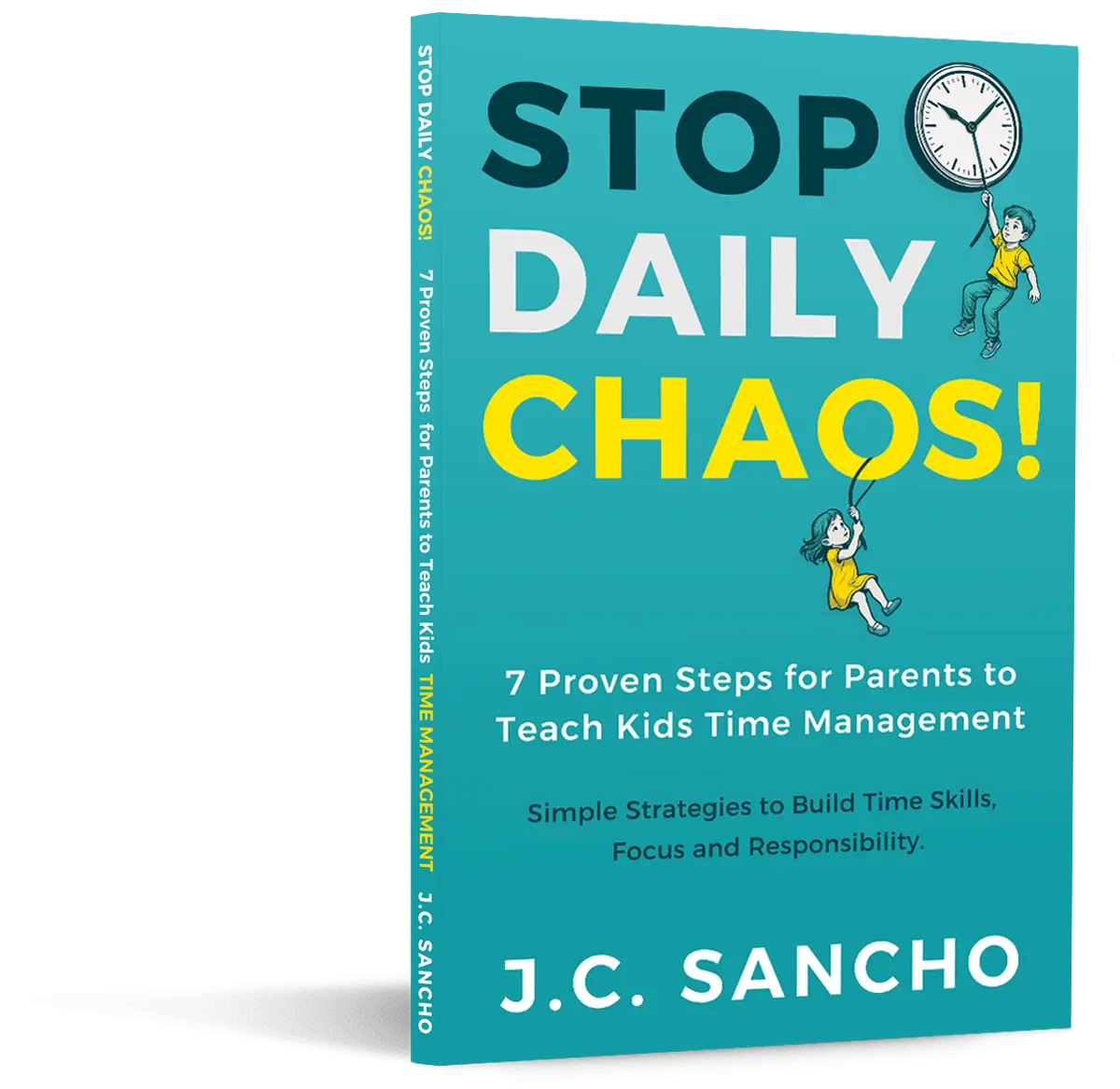
This is also where Time Management for Kids quietly enters the picture. Young children don’t manage time the way adults do. They manage energy, emotion, and impulse. When we help them understand time in concrete ways, we give their nervous system something steady to hold onto.
What Self-Control Actually Means in Early Childhood
When parents hear “self-control,” they often think of behavior: sitting still, waiting turns, stopping when asked. Underneath those behaviors, though, are several developing systems working together.
- Impulse control — pausing before acting
- Emotional regulation — staying within a manageable emotional range
- Attention control — shifting or sustaining focus
- Body regulation — managing hunger, fatigue, sensory input
In early childhood, these systems are still wiring up. The prefrontal cortex — the brain region involved in planning and inhibition — develops gradually over many years. A three- or four-year-old’s emotional brain is powerful. Their reasoning brain is under construction.
So when a child grabs a toy, melts down at transitions, or shouts “No!” at bedtime, we’re often seeing a nervous system that is overloaded, not a child who is willfully defiant.
That distinction matters. Shame shuts down learning. Safety builds it.
Why Emotional Safety Is the Foundation
A child cannot practice self-control when they feel threatened, embarrassed, or disconnected. Emotional safety means your child trusts that big feelings won’t cost them connection.
Picture this: your five-year-old spills juice after you asked them to carry it carefully. You see the puddle spreading. You feel the spike of irritation. You say, sharply, “Why don’t you ever listen?”
In that moment, their nervous system registers criticism. Instead of thinking about grip strength or moving slowly, they’re focused on your tone, your face, and the risk of losing approval.
Now imagine a different response: “That spilled. Let’s grab a towel. Next time we’ll use two hands.”
Same limit. Different emotional climate.
Emotional safety does not mean permissiveness. It means separating the child from the behavior. “I won’t let you hit” lands differently than “You’re being bad.” The first protects safety and teaches a boundary. The second attacks identity.
Over time, children who feel safe with their mistakes are more willing to try again. That’s the soil self-control grows in.
Body Literacy: The Missing Piece in Self-Control
Many early childhood struggles are body-based before they are behavior-based. A hungry child is not choosing to be irritable. A tired child is not strategically resisting bedtime. They are dysregulated.
Body literacy means helping children notice and name internal cues: hunger, fullness, fatigue, tension, the need for movement.
Here’s what that can sound like in daily life:
“Your voice is getting louder. I wonder if your body needs a break.”
“Your hands are squeezing tight. Are you feeling frustrated?”
“It’s been a long morning. Your body might be tired.”
Instead of telling a child to “calm down,” we help them understand what’s happening inside.
This matters for self-control early childhood development because regulation starts in the body. When children learn to recognize early signals — tight chest, wiggly legs, heavy eyes — they can act sooner. That’s far easier than trying to recover from a full meltdown.
Body literacy also supports Time Management for Kids. Young children don’t yet grasp clock time abstractly. But they understand routines connected to bodily states:
- Snack before we get too hungry
- Rest before we get overtired
- Bathroom break before the car ride
These are time anchors that prevent unnecessary emotional crashes.
What’s Happening Underneath the Behavior
Let’s look at a common scene: you say it’s time to leave the playground. Your child screams and runs the other direction.
On the surface, it looks like defiance. Underneath, several things may be happening:
- Their brain struggles with shifting attention from something pleasurable.
- They don’t yet have a strong internal sense of “later.”
- The transition feels abrupt and physically uncomfortable.
- They sense your urgency, which heightens their stress response.
Young children experience time as “now” and “not now.” Ten minutes from now is abstract. That’s why simply saying, “We’re leaving soon,” rarely works on its own.
From a behavior science perspective, transitions are high-demand moments. They require stopping one action, inhibiting impulse, tolerating disappointment, and initiating a new task. That’s a lot for a developing brain.
When we see behavior as communication — “This shift is hard for me” — we can adjust the environment instead of escalating the power struggle.
Practical Tools for Building Self-Control at Home
1. Make Time Visible
Because Time Management for Kids is largely external at first, children benefit from seeing time, not just hearing about it.
Try:
- A visual timer that shows a colored section disappearing
- A simple picture schedule for the morning routine
- A two-minute sand timer for turn-taking
Instead of “Hurry up,” you can say, “When the red is gone, it’s time to clean up.” The timer becomes the neutral authority. You step out of the adversarial role.
In practice, this might look like:
“You have five more minutes to build. I’ll set the timer.”
Timer rings.
“It’s hard to stop. Let’s take a picture of your tower so you can rebuild later.”
You’re teaching transition tolerance, not demanding instant compliance.
2. Practice Waiting in Small, Structured Ways
Waiting is a core self-control skill. But expecting a preschooler to wait ten minutes without practice is unrealistic.
Start tiny.
“I’m going to finish stirring this, then I’ll help you. That’s about 30 seconds.”
Over time, stretch it gently. Celebrate effort: “You waited while I finished. That was hard.”
This reinforces capacity rather than criticizing impatience.
3. Build Predictable Routines
Predictability reduces cognitive load. When children know what comes next, they don’t have to spend as much energy managing uncertainty.
A consistent bedtime routine might look like:
- Bath
- Pajamas
- Two books
- Song
- Lights out
If your child protests at “lights out,” you can calmly refer back to the known structure: “After the song, it’s sleep time.”
This is early Time Management for Kids in action. They begin to internalize sequence, duration, and expectation.
4. Teach Replacement Behaviors
Telling a child what not to do leaves a gap. Telling them what to do builds skill.
Instead of: “Stop grabbing.”
Try: “If you want a turn, say, ‘Can I have it when you’re done?’”
Then practice it during calm moments. Role-play with stuffed animals. Make it playful.
Self-control improves when children have a script ready.
5. Support Physical Regulation
Movement breaks are not indulgences. They’re regulation tools.
If your child is asked to sit for dinner after a long car ride, their body may need input first. Two minutes of jumping, pushing against a wall, or carrying laundry can reset their nervous system.
You might say, “Your body looks wiggly. Let’s do ten frog jumps before we sit.”
This approach respects biology instead of framing movement as misbehavior.
Common Responses That Undermine Self-Control
Overexplaining in the Heat of the Moment
During a meltdown, the reasoning brain is offline. Long lectures about gratitude or fairness won’t land. Keep language short and steady.
“You’re upset. I won’t let you throw.”
Save teaching for later, when everyone is regulated.
Using Shame as a Shortcut
“Big kids don’t act like that.”
“That’s embarrassing.”
Shame can stop behavior quickly, but it does not build internal control. It builds anxiety and secrecy.
Expecting Adult-Level Time Awareness
“We’re late!” means little to a four-year-old. They don’t yet grasp social urgency tied to clock time.
Instead, adjust the environment: start earlier, use visual cues, reduce competing distractions.
Ignoring Parent Mental Health
Your nervous system teaches more than your words. If you’re chronically depleted, your threshold for frustration lowers. That’s human.
Parent mental health is directly connected to children’s regulation. When you take a breath before responding, you are modeling self-control in real time.
If you notice frequent yelling, persistent irritability, or feeling emotionally numb, it may be worth speaking with a healthcare professional. Supporting yourself is not separate from supporting your child.
When to Seek Additional Support
All young children struggle with impulse control. However, some signs suggest a need for further evaluation:
- Frequent aggression that causes harm
- Extreme difficulty with transitions across settings
- Sleep problems that significantly disrupt daily functioning
- Persistent delays in language or social interaction
- Regression after trauma or major change
If these patterns are intense, worsening, or interfering with preschool or family life, consult your pediatrician or a licensed child development specialist. Early guidance can make daily life smoother and prevent secondary struggles.
This article is educational and not a substitute for personalized medical or psychological care.
Helping Children Internalize Time and Control Over Time
As children approach kindergarten, you can gently expand their sense of time ownership.
For example, in the morning:
“We need to leave in 20 minutes. You can choose: get dressed first or eat breakfast first?”
You’re offering limited autonomy within structure. That balance strengthens executive function.
Another example:
On Sunday evening, sit together and sketch the week in simple drawings: school days, soccer, grandma’s visit. Refer back during the week: “Today is a school day. Tomorrow is grandma’s day.”
This builds temporal awareness in concrete form.
Eventually, children begin to say things like, “I need to brush my teeth before books.” That’s internalization. It didn’t come from pressure. It came from repetition, safety, and clarity.
The Long View: What Self-Control Really Grows Into
In early childhood, self-control looks small and messy. It’s a three-year-old squeezing their fists instead of hitting. It’s a five-year-old taking a breath before shouting. It’s a child who still cries at bedtime but walks upstairs anyway.
These are not dramatic transformations. They are incremental rewiring.
When we combine emotional safety, body literacy, predictable structure, and realistic expectations around Time Management for Kids, we reduce unnecessary battles. More importantly, we teach children how to understand themselves.
Self-control is not about suppressing emotion. It is about tolerating it. It is about feeling anger without becoming aggression, feeling disappointment without collapsing, feeling excitement without losing all limits.
That capacity grows in relationship.
So the next time your child cries over the blue cup, pause. Notice your own body. Lower your voice. Offer the limit. Offer the connection.
You are not just getting through dinner. You are building a nervous system that can handle life — one small, ordinary moment at a time.